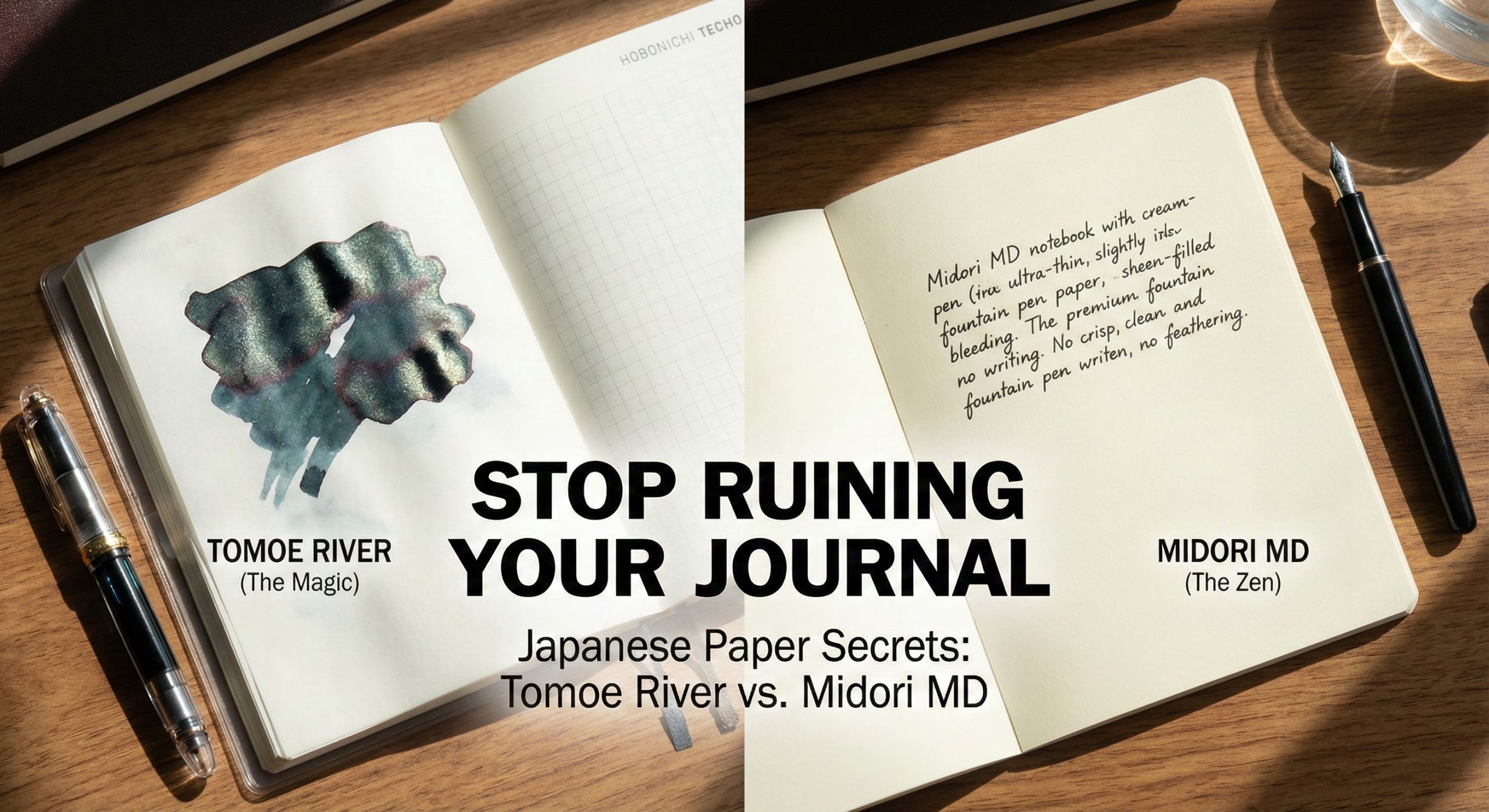
Imagine this: You finally bought that beautiful fountain pen you’ve been eyeing. You dip it in your favorite shimmering ink, open your notebook, and write your first word.
But instead of a crisp, clean line, you see disaster.
The ink spreads out like a spiderweb (feathering). You turn the page, and the ink has soaked all the way through to the other side (bleed-through), ruining the next page.
If you are a Bullet Journaler or a stationery lover in the US, you have probably experienced this heartbreak with standard drugstore notebooks—or even expensive brands like Moleskine.
Here is the secret: The problem isn’t your pen. It isn’t your ink. It’s your paper.
In Japan, paper isn’t just a supply; it is a craft. Japanese manufacturers treat paper making with the same dedication as sword making. Today, I’m going to introduce you to the two “Holy Grails” of Japanese paper that will change your writing life forever: Tomoe River and Midori MD.
The “Big Three” Paper Crimes: What to Avoid
Before we dive into the magic, let’s clarify what we are fighting against. If you want to enjoy fountain pens, you need to avoid these three enemies:
- Bleed-through: When ink soaks through to the back. (The worst enemy!)
- Feathering: When ink spreads into the paper fibers, making your writing look fuzzy.
- Ghosting: When you can see the shadow of your writing on the reverse side.
- Note: Japanese paper is often thin, so some ghosting is normal. Many fans (myself included) actually love this “crinkly” used-notebook feel!
So, how do Japanese papers solve this?
The Legend: Tomoe River Paper (The “Magic” Paper)
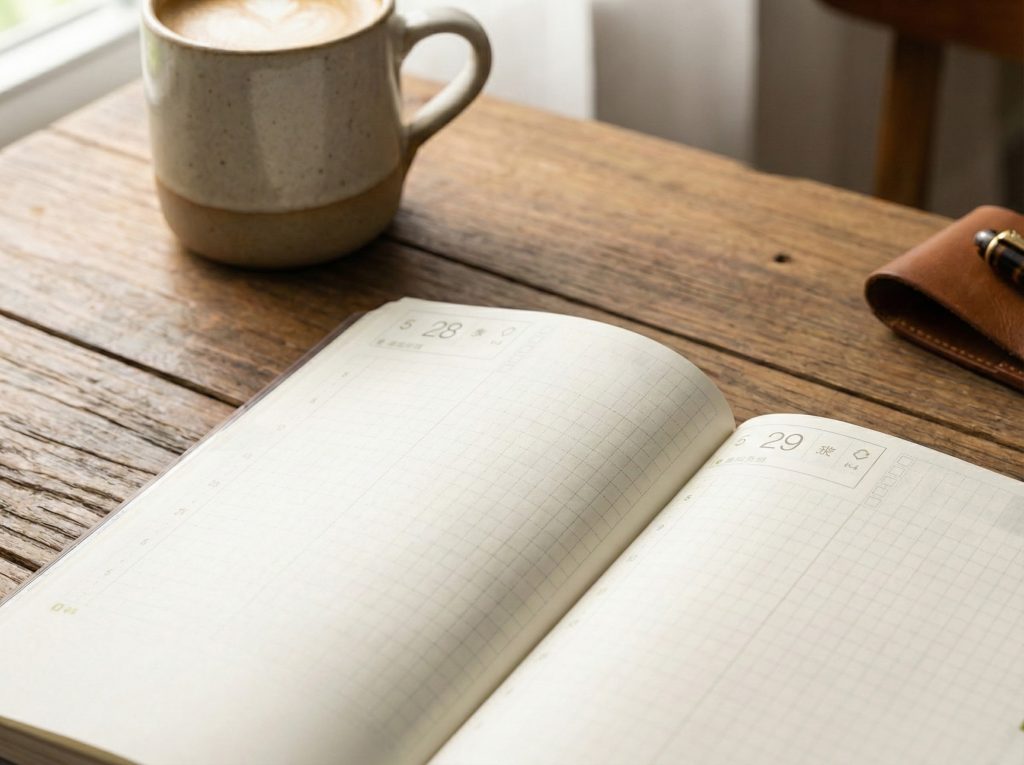
If you ask any fountain pen enthusiast, “What is the best paper in the world?”, 9 out of 10 will scream “Tomoe River!”
This paper is famously used in the cult-favorite planner, the Hobonichi Techo.
Why is it magical?
- Impossibly Thin: It is incredibly thin and lightweight (52gsm). You can fit hundreds of pages in a slim notebook. It feels delicate, almost like Bible paper.
- Zero Bleed: Despite being so thin, it is coated in a way that prevents ink from soaking in. The ink sits on top of the paper.
- Sheen & Shading: Because the ink sits on top, it dries slowly. This allows the ink to pool and create beautiful color variations (shading) and shiny outlines (sheen). Your ink will look 10x more beautiful on this paper than on copy paper.
Best for: People who love colorful inks, sheen, and the Hobonichi Techo.
👉 Check out the Hobonichi Techo on Amazon
The Minimalist: Midori MD Paper (The “Zen” Paper)
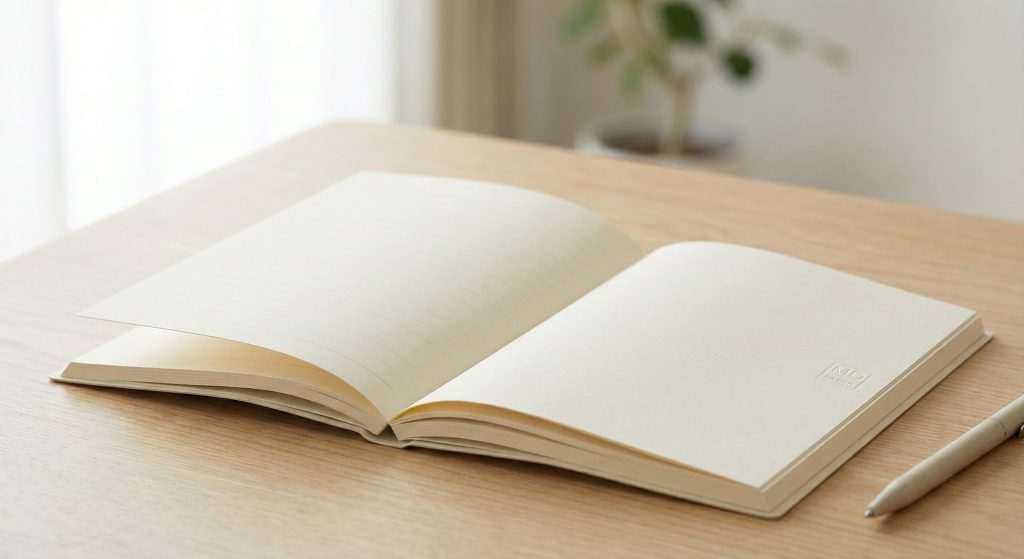
If Tomoe River is the “Magician,” Midori MD (Midori Diary) is the “Zen Monk.”
Developed in the 1960s solely for writing comfort, this paper has a loyal following among writers and artists who value focus and simplicity.
Why is it special?
- The “Tooth” (Texture): Unlike the slippery Tomoe River, MD Paper has a slight texture. When you write, you can feel a subtle resistance and hear a satisfying scratch-scratch sound. It feels like you are truly writing.
- Creamy Comfort: The paper is not stark white; it is a gentle cream color that is easy on the eyes, perfect for long journaling sessions.
- Minimalist Design: The notebooks often come with no cover or distractions. It is just you and your thoughts.
Best for: Writers who want tactile feedback and a distraction-free experience.
👉 Check out the Midori MD Notebook on Amazon
Showdown: Which One Should You Choose?
Still can’t decide? Here is a quick cheat sheet to help you pick your fighter.
| Feature | Tomoe River (Hobonichi) | Midori MD Paper |
| Feel | Smooth, slippery, glass-like | Tactile, slight resistance |
| Drying Time | Slow (Ink sits on top) | Medium (Absorbs slightly) |
| Thickness | Ultra-thin (52gsm) | Standard (Creamy & Sturdy) |
| Ink Look | High Sheen & Shading ✨ | Clean & Crisp 🖊️ |
| Vibe | Magical & Delicate | Zen & Robust |
Conclusion: Upgrade Your Analog Life
Life is too short to use bad paper.
Whether you choose the magical thinness of Tomoe River or the tactile satisfaction of Midori MD, one thing is certain: once you try Japanese paper, you can never go back to generic office supplies.
Your fountain pens deserve a playground. Why not grab one of each and see which one speaks to your soul?
Have you tried Japanese paper before? Let me know your favorite in the comments below!

コメント