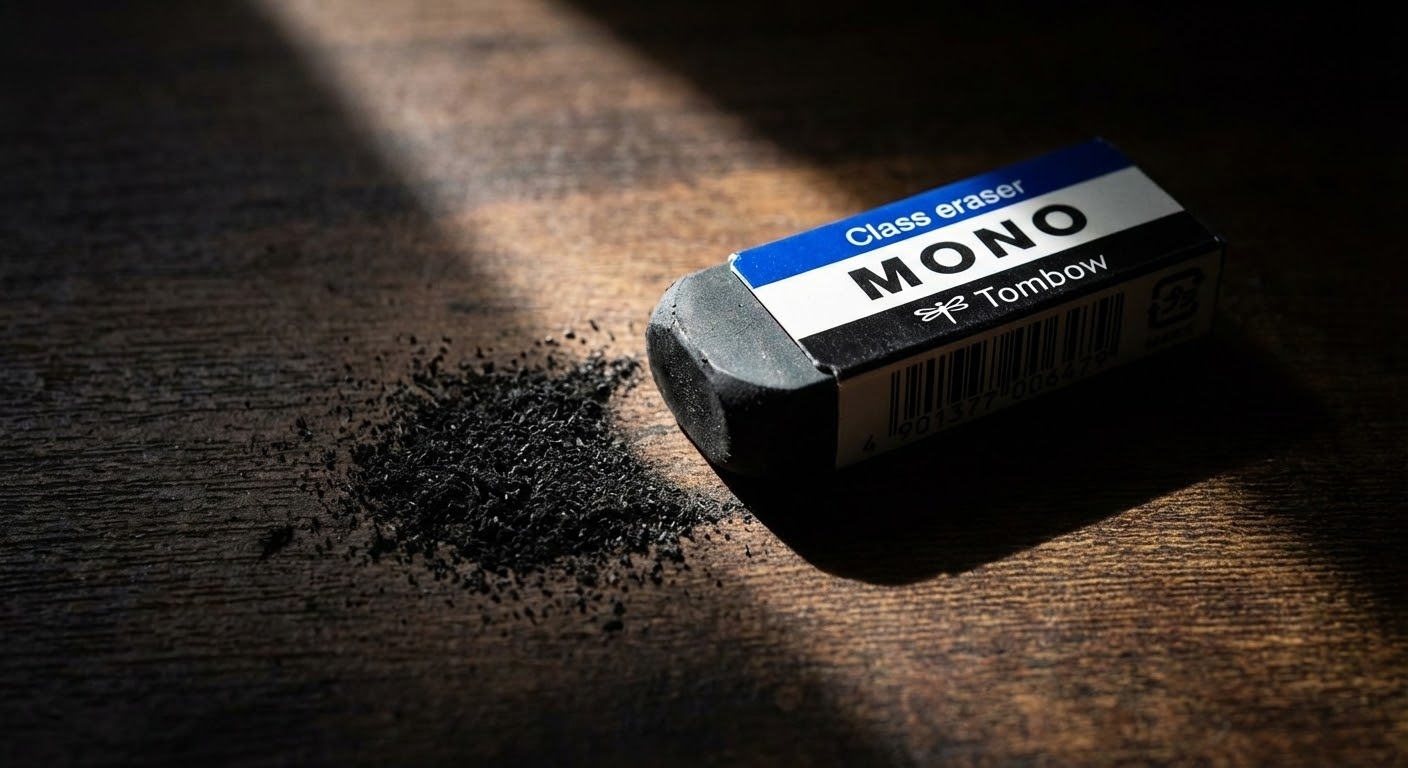
Let’s talk about mistakes. When you make a mistake in your notebook, what happens?
If you use a standard pink eraser found in most US offices, the result is usually a tragedy. The paper gets crumpled, the graphite just smears into a grey blob, and sometimes you even tear a hole in the page.
In Japan, erasing is not just “undoing.” It is a reset. It is a cleaning ritual. Japanese companies have turned the humble eraser into a high-tech tool that lifts graphite off the paper without damaging the delicate fibers underneath.
Today, I will introduce you to three Japanese erasers that will make you want to make mistakes, just so you can use them.

1. The Icon: Tombow MONO
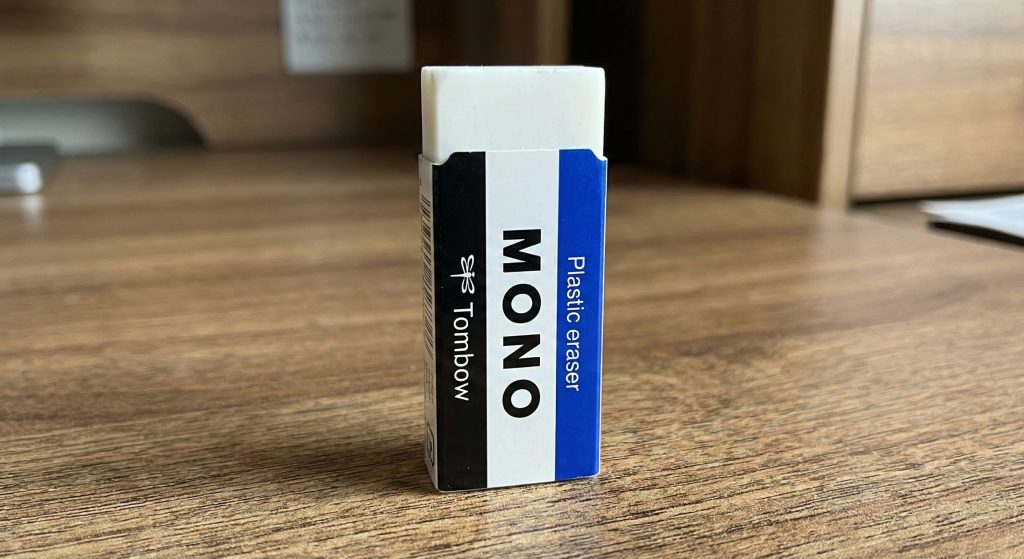
If you walk into any classroom or office in Japan, you will see this blue, white, and black striped block. Since 1969, the Tombow MONO has been the gold standard.
Why it’s special: It is perfectly balanced. It’s not too hard, not too soft. It catches the graphite particles with a light touch and clumps the dust together so you can clean it up easily. It is the definition of reliability.
👉 Check out Tombow MONO on Amazon
2. The Performance King: PLUS Air-In
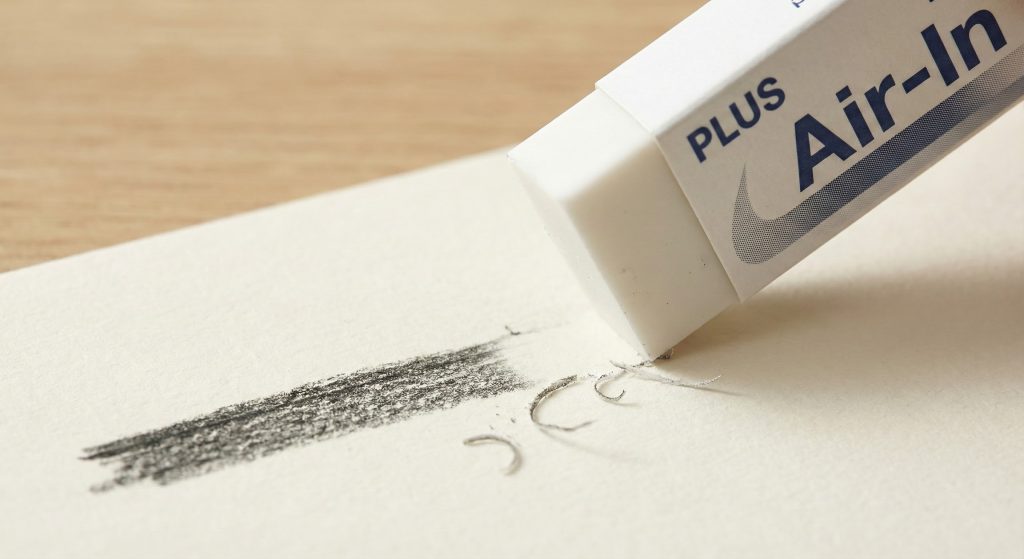
The Concept: “Always erasing with a sharp corner.”
The PLUS Air-In feels different. As the name suggests, it feels as light as air. You don’t need to scrub; you just glide. Because the material is slightly harder than the MONO, it doesn’t wear down as fast, and it maintains its shape better.
👉 Check out PLUS Air-In on Amazon
3. The Art Piece: PLUS Mt. Fuji Eraser
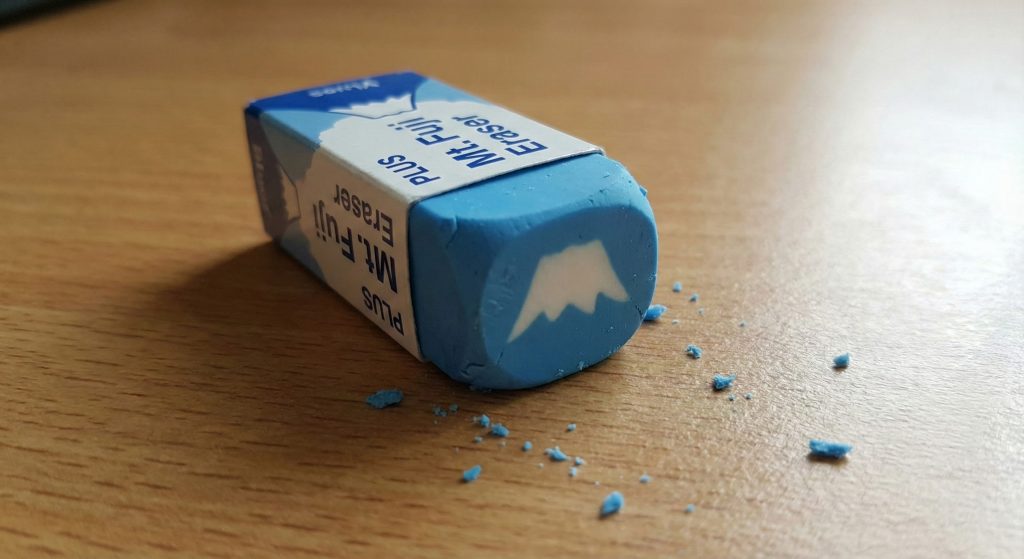
The Gimmick: It turns into a mountain.
At first glance, this looks like a normal rectangular eraser. But the inside layer is white, and the outside layer is blue (or red). As you use the corners, the white center is revealed, creating the snow-capped peak of Mount Fuji.
It sounds like a toy, but because it is made by PLUS (the same company as Air-In), the erasing quality is top-tier. It is the #1 souvenir for stationery lovers visiting Japan.
👉 Check out Mt. Fuji Eraser on Amazon
Conclusion: A $2 Upgrade
You spend money on good pens and good notebooks. Why ruin them with a cheap eraser? For just a couple of dollars, you can turn the stressful act of “correcting a mistake” into a satisfying moment of clarity.
Which one would you choose? The classic MONO, the high-tech Air-In, or the beautiful Mt. Fuji?

コメント