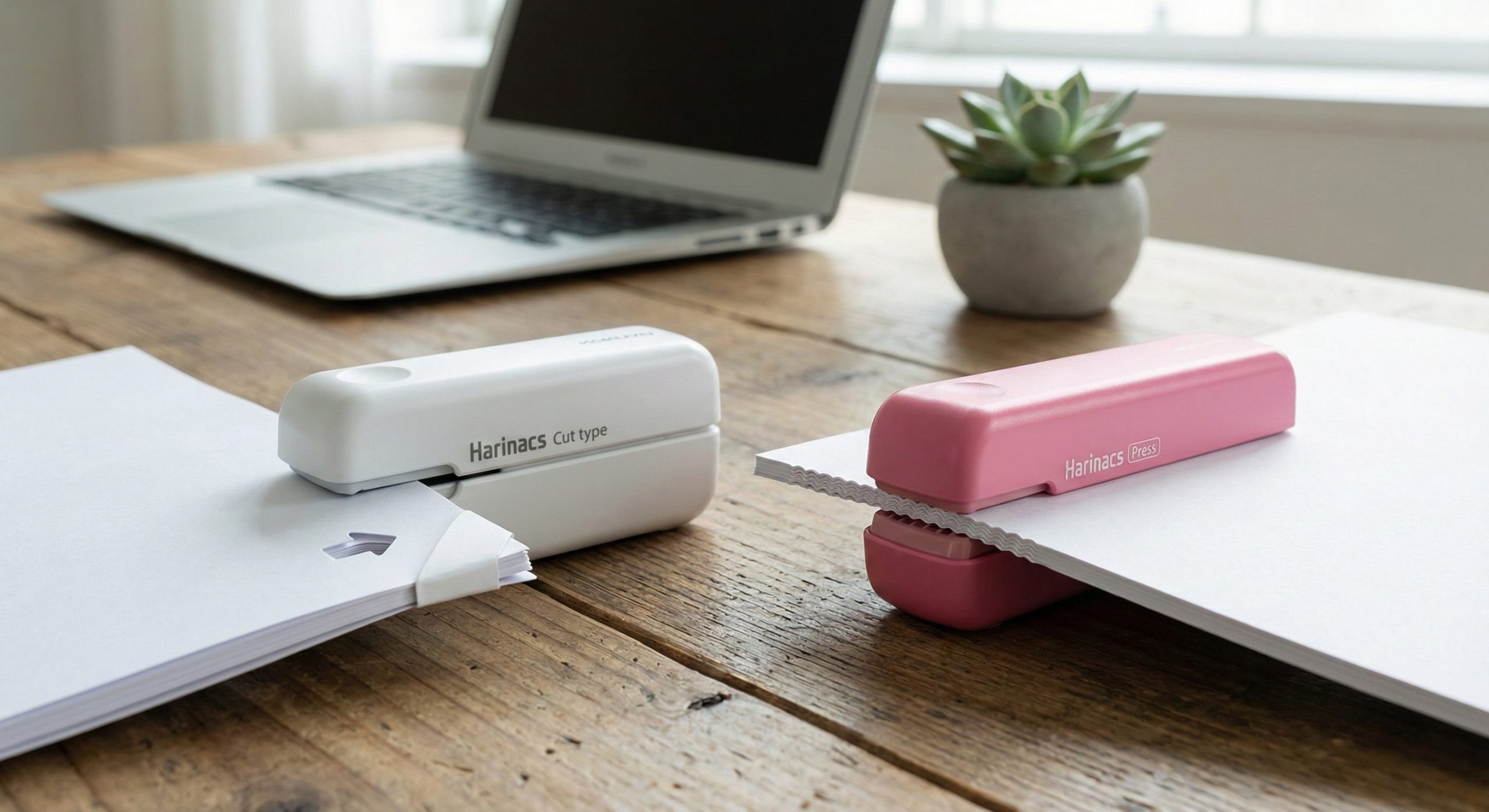
Let’s talk about the “Empty Stapler” struggle. You are rushing to finish a report. You press down on your stapler. Crunch. Nothing happens. You are out of staples. Or perhaps you are standing over the shredder, wasting valuable minutes prying metal needles out of documents so you can recycle the paper.
Japan, a country obsessed with efficiency and strict recycling laws, solved this problem with a tool that feels like magic: The Harinacs (Stapleless Stapler). It looks like a stapler, but it uses no metal. Instead, it “sews” or “crimps” the paper together using the paper itself.
But not all stapleless staplers are created equal. In this guide, we dive deep into the mechanism, the types, and why this Japanese invention is the ultimate desk upgrade.
The Core Mechanism: How Does It Work?
Unlike a traditional stapler that drives a U-shaped wire through paper, the Harinacs utilizes the paper’s own strength. There are actually two distinct mechanisms dominating the market today.

A. The “Cut and Tuck” Type (The Classic)
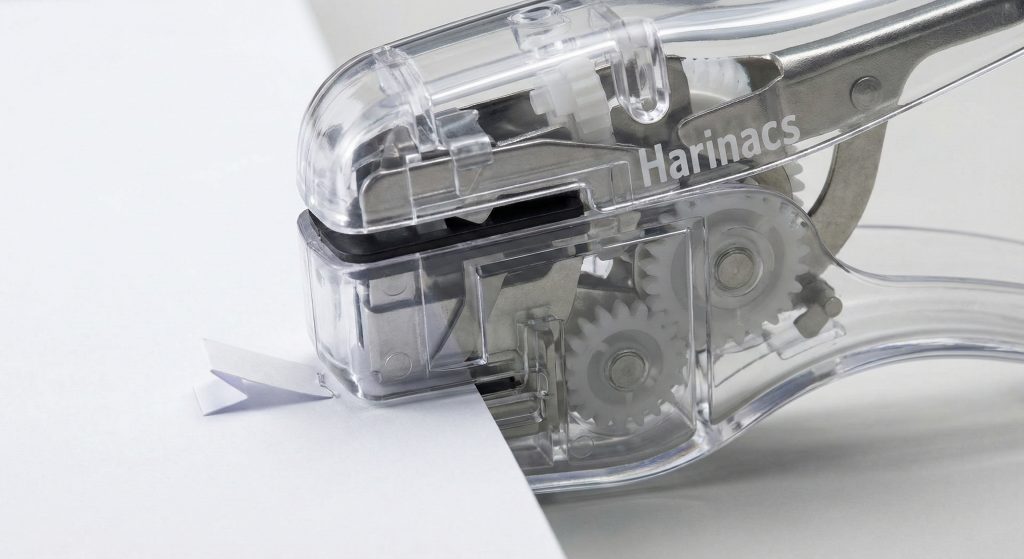
This model earned the nickname “Office Origami.” When you press the lever:
- A blade punches a U-shaped tab and a receiving slit.
- The mechanism folds the tab back.
- It tucks the tab into the slit to lock it.
- Best for: 5–10 sheets. Reports intended to be read and flipped through.
- The Feel: A satisfying ka-chunk sound with strong tactile feedback.
B. The “Press” Type (The Modern Evolution)
This type does not cut a hole. Instead, it uses high pressure to crimp the paper fibers together, creating a waffle-like pattern on the edge.
- Best for: 5 sheets or less. Receipts, temporary memos, or documents you don’t want to damage with holes.
- The Feel: A silent, smooth squeeze.
The “Why”: Why Japan Obsesses Over This Tool
Why did Kokuyo invest so much R&D into this? The answer lies in Japan’s strict waste separation culture.
- The Recycling Friction: In Japanese offices, separating “burnable” waste from “recyclable” paper is mandatory. Removing hundreds of tiny metal staples is a significant productivity killer.
- Safety & Food Industry: In factories (especially food processing), metal staples are a contamination risk. A stapleless solution eliminates the danger of a stray needle entering a product.
Pros and Cons: Is It Right for You?
To give you an honest recommendation, we must look at the limitations.
✅ The Pros (Why you need it)
- Infinite Capacity: You never need to buy refills. As long as you have paper, you can bind.
- Shredder Ready: Toss documents straight into the shredder. No prep work required.
- Flat Stacking: Unlike metal staples which stack up and create a “bulge” in the corner of a file, the Harinacs binding is relatively flat.
❌ The Cons (What to watch out for)
- Sheet Limit: Most models max out at 5–10 sheets. It cannot handle a 30-page contract.
- Holding Power: It is weaker than metal. If you pull hard, the paper might tear or detach.
Comparison: Which Model Should You Buy?
👉 Check out the full Harinacs Collection on Amazon
Conclusion: A Tiny Revolution
The Harinacs proves that innovation doesn’t always mean “adding technology.” Sometimes, it means removing unnecessary parts (like the metal needle) to create a smoother, more sustainable workflow. Stop hunting for staple refills. Start folding your way to a cleaner desk.


コメント